


Can you learn cross stitch as a complete beginner?
Yes — cross stitch is the most beginner-friendly needlework there is, and most people can stitch their first recognisable motif in under 30 minutes. It uses one repeating stitch worked on grid fabric, so there is no freehand drawing, no curved shaping, and nothing to memorise beyond “up at bottom-left, down at top-right.” Unlike embroidery, where you manage six or more stitch types and fabric tension by eye, counted cross stitch hands you a pre-planned grid: every colour and every hole is already decided by the chart before you thread a needle.
Everything below turns that into decisions you make once and stop thinking about: which fabric, which needle, how many strands, which pattern, and how to finish so your first piece survives framing.
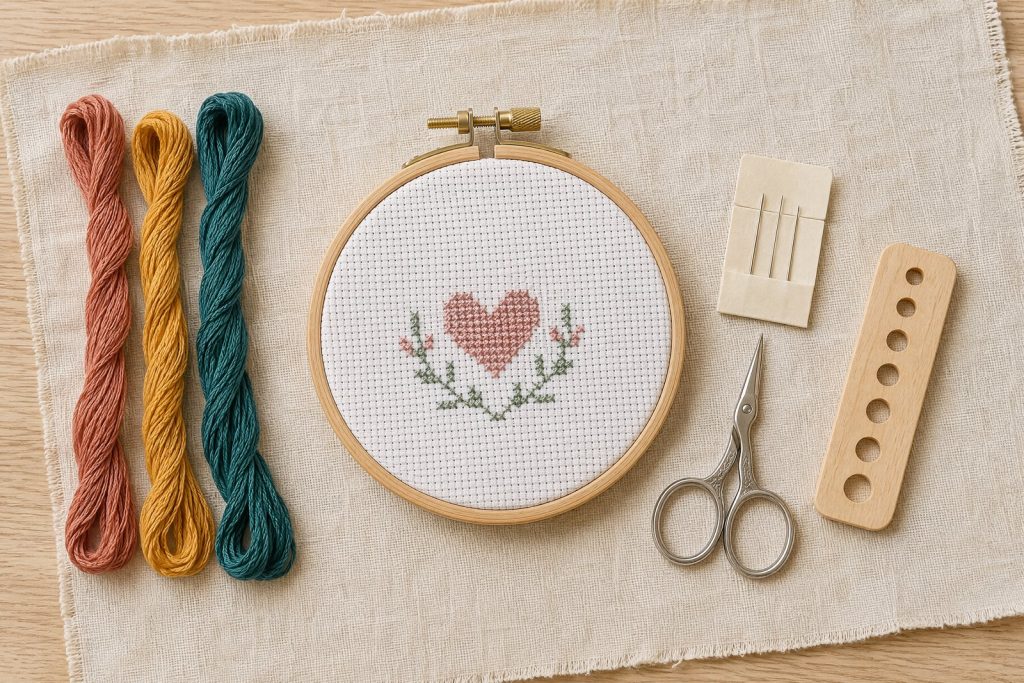
Gather these seven supplies before you stitch a single cross
You cannot start with less than this. The “skip it / don’t skip it” column is the part most beginner guides leave out.
| Supply | What beginners should buy | Skip it / don’t skip it |
|---|---|---|
| Aida fabric | 14-count white Aida, 30 × 30 cm (12 × 12 in) | Don’t skip. This is the grid itself. |
| Embroidery floss | 4–6 skeins of stranded cotton (DMC or Anchor), light + dark + 1 white | Don’t skip. Six strands separate into workable threads. |
| Tapestry needle | Size 24, blunt tip | Don’t skip. Sharp needles pierce floss instead of passing through holes. |
| Embroidery scissors | Small 10–13 cm spring or curved-blade scissors | Don’t skip. Paper scissors shred thread and blunt quickly. |
| Hoop or frame | 15 cm (6 in) bamboo hoop with a tightening screw | Optional. Usable without, but it keeps tension even and fabric clean. |
| Pattern or kit | A kit with pre-sorted thread and printed chart, or a 100 × 100-stitch PDF | Don’t skip. Stitching without a chart is just darning. |
| Good light | Daylight-position lamp, 4000–5000 K, aimed at the hoop | The most underrated item. Most beginner quitting happens at 11 p.m. with a yellow ceiling light. |
Kits vs. buying separately. A good beginner kit includes Aida fabric, pre-sorted threads, a tapestry needle, a printed chart and clear instructions. It costs more per square centimetre of fabric, but it removes three early failure points — wrong needle size, wrong strand count, a pattern that is too big. Buy components separately on your second project, not your first. If you want the all-in-one route, pick an all-in-one starter kit that lists fabric count, thread colours and needle size on the product page — if a listing does not state those three, that is your cue to keep shopping.
Choose 14-count Aida as your first fabric
“Count” means the number of fabric blocks (Aida) or threads (evenweave and linen) in one inch. Lay a ruler on the cloth and count the squares across 1 inch: 14 blocks means 14-count fabric. The number is not a difficulty rating you should maximise — it is a resolution setting, and higher resolution means smaller holes and more visible mistakes.
| Fabric count | Squares per inch | Look and feel | Best for | Beginner risk |
|---|---|---|---|---|
| 11-count | 11 | Very open, chunky, stitches quickly | Blankets, coasters, kids’ projects | Lowest — but finished motifs look coarse and pixelated |
| 14-count | 14 | The default. Balanced, cheap, everywhere | First project, samplers, gifts | Low — start here |
| 16-count | 16 | Finer, tighter, slightly harder on the eyes | Bookmarks, cards, jewellery | Medium |
| 18-count | 18 | Dense; mistakes become obvious | Experienced beginners, fine detail | High |
| 25 / 28-count evenweave or linen | 25–28 threads, usually stitched over 2 | Heirloom look, fabric drapes | Cushions, framed pictures, clothing | High — not for project one |
Two consequences worth knowing before you buy:
- Fabric count determines finished size. A design’s stitched dimensions are simply its stitch count divided by the fabric count. The Cross Stitch Guild’s worked example: 140 stitches ÷ 14-count Aida = a 10-inch (25.5 cm) design. Change the fabric and you change the object — the same chart on 11-count grows roughly 27%, on 18-count shrinks roughly 22%.
- Evenweave maths trips people up. Stitching 28-count evenweave over 2 threads produces the same finished size as 14-count Aida; 32-count over 2 ≈ 16-count Aida; 36-count over 2 ≈ 18-count Aida.
Why kit listings say 11CT, 14CT or 16CT. Count is not a difficulty rating to maximise – it sets the finished size and how the work feels. The three counts you will actually meet are 11CT, 14CT and 16CT: 11CT has the largest holes and the chunkiest result (3-4 strands, easiest on the eyes), 14CT is the balanced middle ground (2 strands), and 16CT gives finer detail for more patience (2 strands). The same chart worked on 11CT finishes about 27% larger than on 14CT, so confirm the count before you commit to a large design. Kits in all three counts are listed in the Cross Stitch kit range.
Cut your fabric before you cut anything else
Calculate the stitched area first, then add margin. The Cross Stitch Guild adds 5 inches (13 cm) to both dimensions for a piece that will be stretched, framed or mounted, reducing to 3 inches (7.5 cm) for smaller projects. Leaving only a tight border is the most common unrecoverable beginner error — you cannot sew back fabric you cut away.
Learn how to separate floss strands before you thread a needle
Embroidery floss is stranded cotton: each skein holds six thin strands twisted together, and patterns tell you how many to use. Ignoring this is the single fastest way to make a beginner piece look wrong — six strands on 14-count Aida is lumpy and will not pass through the same hole twice. Kit suppliers also sell more than one grade of thread: BOHUI lists its multi-colour embroidery floss in eco-cotton or long-staple (Egyptian) cotton. Whatever brand you use, photograph the colour card before you start — that is the only way to re-order a shade two years later.
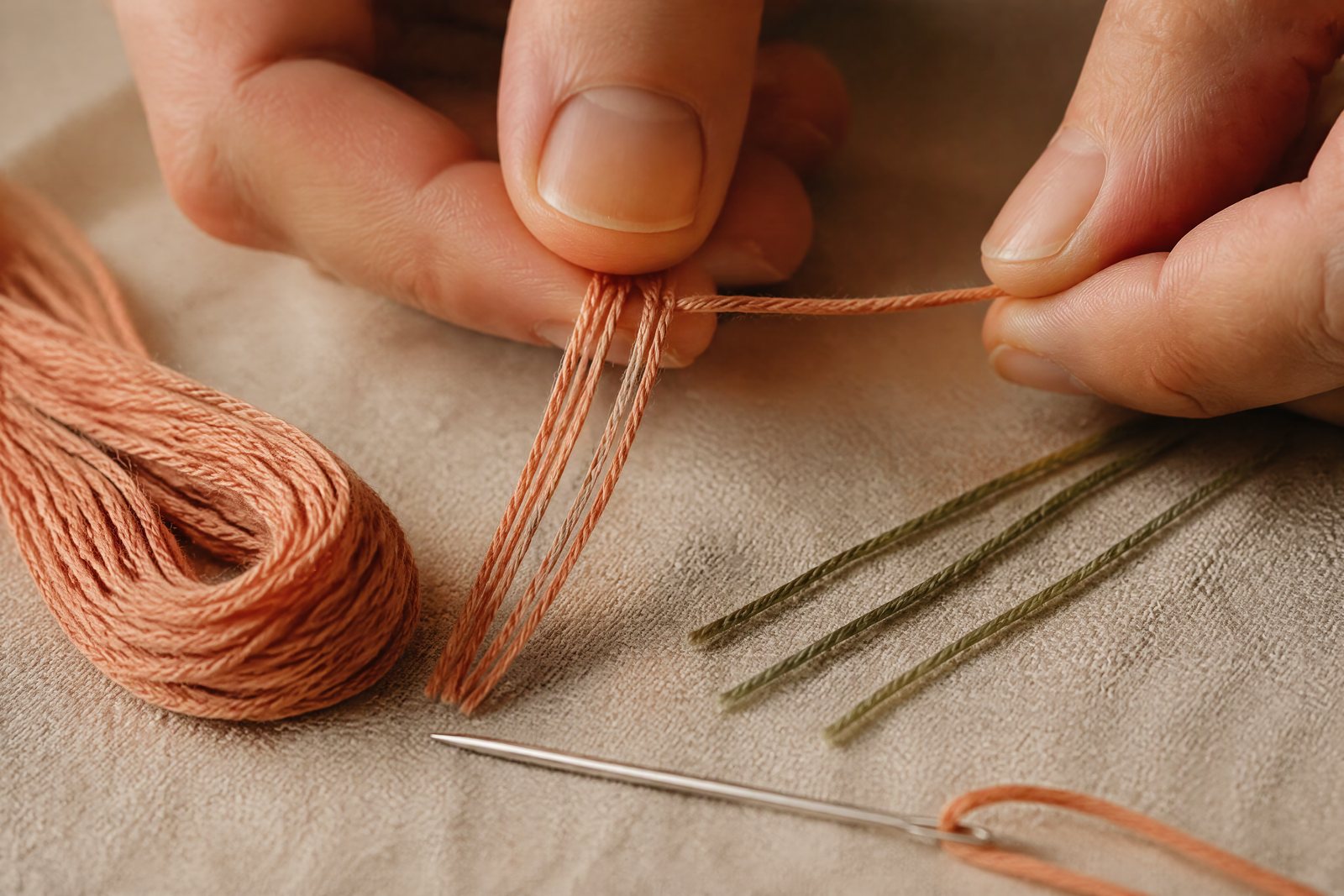
How to split thread: pull an arm’s length from the skein, fold it in half and pull the loop out of the cut end. Then hold the bundle still and slide one strand out by pulling along its length, not sideways. Never push the whole six-strand bundle through the needle eye and try to thin it down on the fabric.
| Fabric | Typical strands of 6-strand floss |
|---|---|
| 11-count Aida | 3–4 |
| 14-count Aida | 2 (full cross), 1 (backstitch outline) |
| 16-count Aida | 2 |
| 18-count Aida | 1–2 |
| 25-count linen / evenweave | 1 over 1 thread |
| 28-count evenweave over 2 | 2 |
If your chart does not state a strand count — cheap kits often don’t — pull one thread from the fabric’s selvage edge and compare it with your floss strands: they should be a similar weight, per the Cross Stitch Guild’s field test. Work three test crosses in the margin before committing.
You will also meet tweeding (two colours on the needle at once, worked as one thread, for a heathered effect) and pre-combined variegated ranges. For your first project, ignore both.
Match a size 24 tapestry needle to 14-count Aida
Needle sizing works backwards: the higher the number, the finer the needle. A size 26 is thinner than a size 24. Tapestry needles are blunt on purpose — a blunt tip pushes a fabric hole aside or slides between threads, where a sharp point pierces and frays the floss.
| Fabric | Standard needle | Why |
|---|---|---|
| 11–14-count Aida | Size 24 | The shaft is thick enough to open the hole for you, thin enough to pass through twice |
| 16-count Aida | Size 26 | A 24 starts forcing the weave and distorts tension |
| 18–20-count Aida | Size 26–28 | Fine shaft, larger eye than a sharps needle |
| 25–28-count evenweave / linen | Size 26–28 tapestry or a #9–10 crew needle | You need a slim shaft and a long eye for 1–2 strands |
Length matters as much as thickness. A needle too short for an arm’s length of floss means you push thread through the fabric instead of the needle — how a thread ends up frayed and fuzzy in ten minutes. If threading defeats you when you’re tired, hold the thread taut across a fingertip and rub the eye of the needle up and down it until it pops through.
Pick an easy cross-stitch pattern with these five filters
Run any candidate through this list. If it fails two or more, it is not a beginner pattern whatever the label says.
- Under 10,000 total stitches (roughly 100 × 100). Bigger and you stall before finishing anything — and finishing is where the habit forms.
- Fewer than 8 colours. Each extra colour is another darning tail and another chance to load the wrong thread.
- No fractional stitches (¼ and ¾). Half stitches are manageable; fractions mean stitching into the middle of a fabric hole.
- Minimal backstitch. Backstitch is a second skill; a heavy outline layer doubles the difficulty.
- Solid blocks, not scattered single stitches. A heart or a sampler border forgives wobbly tension; a scattered texture motif shows every inconsistency.
Subjects that reliably pass: small samplers and borders, single flowers and hearts, fruit, flat pixel-art animals, geometric and Nordic patterns. Two structural features are worth filtering for as well: a kit that includes step-by-step instructions rather than a chart alone, and a solid-block subject such as an easy beginner kit whose large colour areas hide uneven tension.
Read a cross-stitch chart before you start stitching
A chart is a grid where one square = one cross stitch and one symbol = one colour:
- Find the centre on both. Charts mark it with diagonal lines or a bold arrow; on the fabric, fold it in quarters and pin the crease intersection. Start there and nothing can end up off-centre.
- Match symbol to colour using the key at the bottom of the chart, which carries a manufacturer number (DMC 321 = red; DMC 712 = cream).
- Stitch one colour at a time, not one row at a time. You finish faster and swap threads less often.
- Count in 10 × 10 blocks, not single squares, and cover the rows you have already done with a sticky note. Single-square counting is where “that doesn’t look right” comes from.
Two things charts never tell you, and this is where beginner frustration actually lives: how many strands to use (table above), and which way your top arms should lean. Decide both once and apply them to every project.
Why the sampler matters (one minute of history)
Cross stitch began as homework, not as a hobby. The Victoria and Albert Museum holds more than 700 needlework samplers, the earliest from 14th–15th century Egypt, and “sampler” comes from the Latin exemplum — an example to copy. Samplers began as personal reference sheets of patterns, became girls’ practice pieces (alphabets for labelling linen, borders for decorating it), and by the 19th century were a schoolroom exercise worked almost exclusively in cross stitch. The beginner sampler you are stitching is that same object, four centuries on.
How to cross stitch, step by step
Use the “two journeys” method: lay all the first legs of a row, then return along it completing them. The Cross Stitch Guild recommends it because it gives neater vertical lines on the back and keeps your top arms automatically consistent. (Not suitable when stitching over a single thread of fine evenweave.)
- Hoop the fabric. Loosen the screw, push the inner ring through the outer, sandwich the fabric, then tighten until it drums when you tap it. Re-tension every sitting.
- Find the centre of design and fabric and place the first stitch there. Starting at a corner instead? Measure an equal, generous margin first.
- Cut 45–50 cm (18–20 in) of floss and separate to the strand count your fabric needs (two, on 14-count). Longer tangles and frays; shorter means constant re-threading.
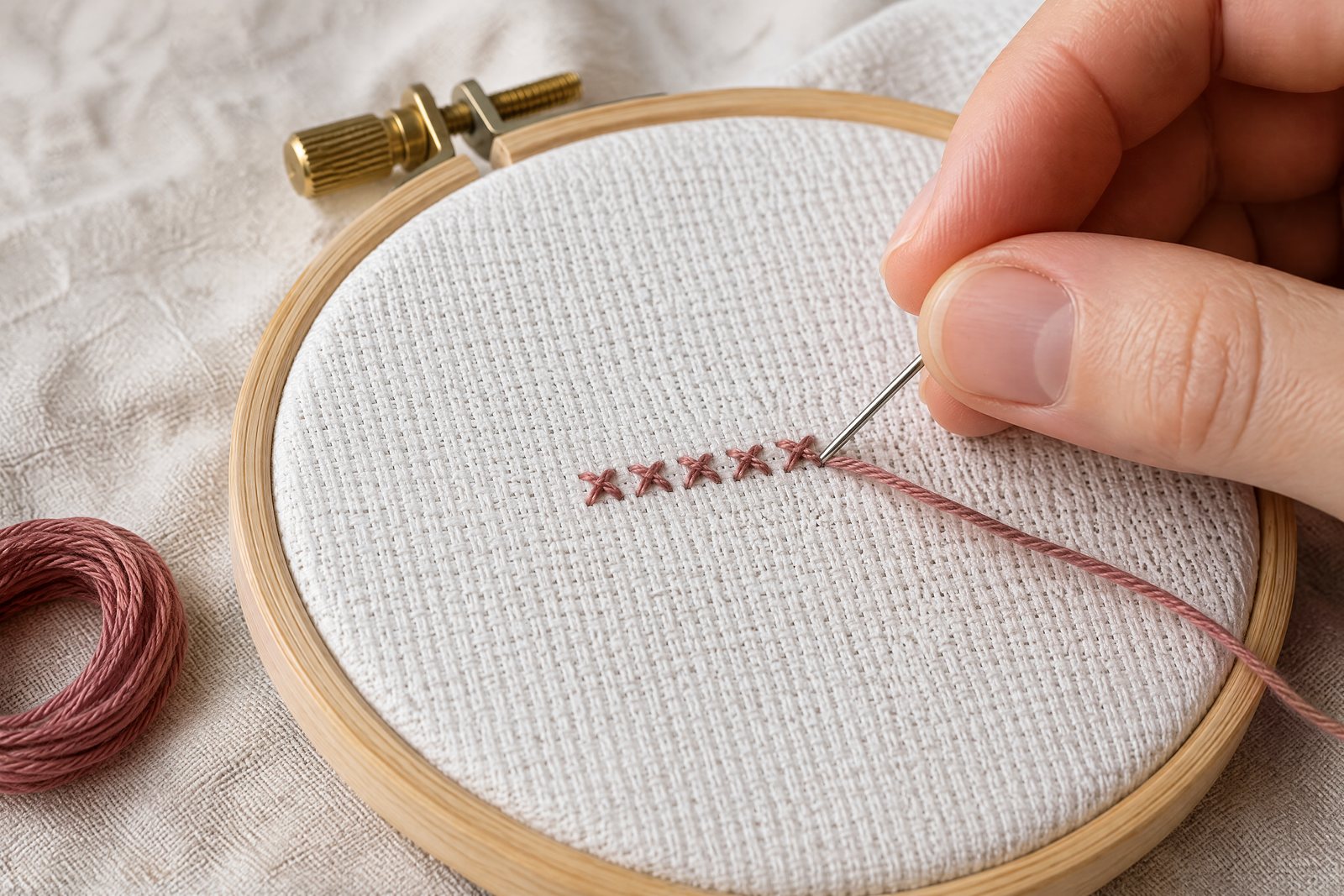
- Bring the needle up from the back at the bottom-left corner of the first Aida block, leaving a small tail loose behind.
- Insert at the top-right corner of the same block, diagonally across, and pull through. That is one half stitch — a single diagonal slash.
- Come up at the bottom-right of the next block and lay a second diagonal parallel to the first; repeat along the row.
- Return journey: stitch the opposite diagonal across each slash so every block gets its second leg. Always run the first leg the same way (bottom-left → top-right is the usual convention), so all top arms finish parallel.
- Anchor, don’t knot. Work your first stitches over the starting tail, or run it under three finished stitches on the back; knots leave lumps under glass. When you stop, take the fabric out of the hoop — Aida stays dented for weeks.
Expect a slower pace than the internet suggests. On 14-count with two strands, a steady beginner manages roughly 500–1,000 stitches per hour — so a 5,000-stitch motif is 6–10 hours of stitching, not one evening.
Fix these seven beginner mistakes before they cost you a project
| Symptom | Actual cause | The fix |
|---|---|---|
| One side of every cross looks “open” or gappy | Top arms lean in mixed directions | Pick one direction now and keep it for the whole project, including the current one. Consistency beats correctness |
| Fabric shows through the stitches | Too few strands, or thread was plied as it was threaded | Re-count strands; thread the needle with the strands lying parallel, not twisted around each other |
| Stitches look lumpy and cover neighbouring holes | Too many strands for the fabric count | Drop to 2 on 14-count, 1 for backstitch |
| The design drifts off-centre or off the fabric | Started at a corner with no margin maths | Restart from the centre fold; add 3 in (7.5 cm) minimum margin, 5 in (13 cm) if framing |
| Thread fuzzes and snaps after a few stitches | Sharp needle, rough hands, or thread dragged across the fabric surface | Blunt tapestry needle; let the needle do the work and never force it through a hole |
| Back of the work looks like a bird’s nest | Long floats between distant colour areas | Stitch colour-by-colour in adjacent blocks; carry thread no more than 3–4 blocks and clip longer runs |
| Hoop-shaped dent around the motif | Fabric left in the hoop between sessions | Store flat, out of the hoop; press from the back on a towel if a mark persists |
Finish your first piece so it survives framing
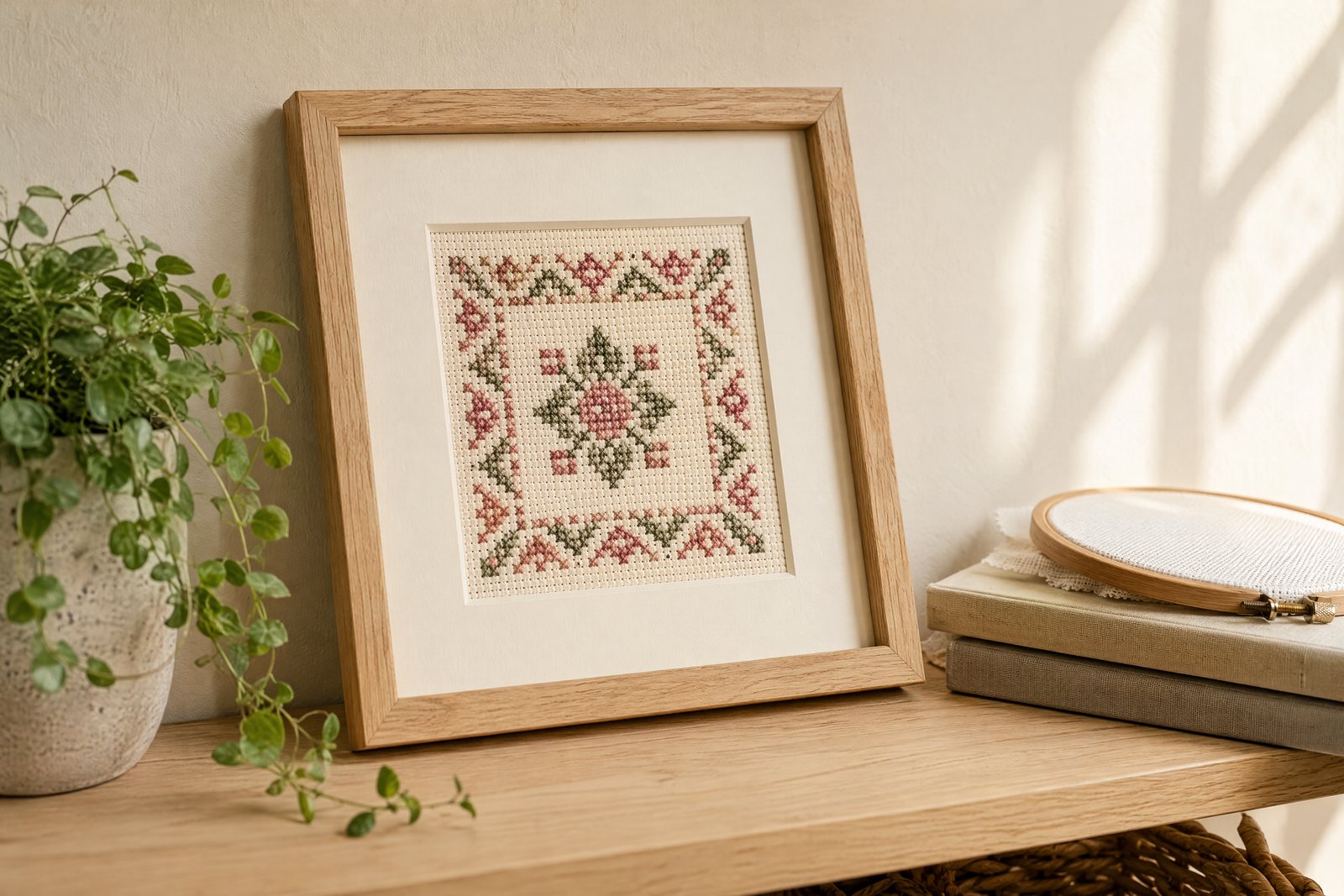
Finishing is a separate skill, and the reason many first projects never get displayed. The order is fixed: clean, dry, then tension.
- Wash out the marks. Hand-wash in lukewarm water with a drop of mild detergent. Press gently; do not rub, twist or scrub, and do not soak darks with whites.
- Test colourfastness first. Press the back of the stitches with a clean, damp white tissue: any colour on the tissue means do not wash or tea-dye. That is the Cross Stitch Guild’s test, and the reason to test before rather than after. DMC, Anchor and Madeira are generally dependable; stubborn “Christmas reds” are the classic exception.
- Dry flat on a clean white towel, away from direct heat and sunlight.
- Press from the back, face-down on a terry towel (which preserves the thread’s raised texture), with a dry iron on a cotton setting, holding the edges square with your fingertips. Never press the front of cross stitch.
- Choose a finishing route, easiest first:
- Hoop display — tighten, tack the excess fabric to the inner ring, hang. No sewing skill required. It is also why some kits are sold with a hoop option: the fabric is cut with margin to spare so it can be laced into the ring.
- Mounting board or frame — lacing or acid-free tape onto a board, then glass. Best-looking result for the least risk, because the glass holds the fabric flat.
- Bands or binding on a cushion or bag — needs the design size calculated before you stitch.
- Fincham, chartek or parchment — for very small motifs on cards and gifts.
Cross stitch vs embroidery vs needlepoint: which craft should you start?
| Counted cross stitch | Surface embroidery | Needlepoint / tapestry | |
|---|---|---|---|
| Stitches to learn | 1 (plus backstitch) | 8–20+ | 3–4 (tent, Scotch, basket) |
| Do you draw the design? | No — chart is the design | Often yes | No — printed canvas |
| Fabric | Aida / evenweave grid | Any woven cloth, tension-critical | Mono / interlock canvas |
| Where the thread sits | On top, over blocks | On the surface, variable depth | Woven through the canvas |
| Covered area | Partial or full, your choice | Mostly lines and motifs | Almost always 100% |
| Unpick difficulty | Easy | Medium (holes remain) | Hard |
| Typical beginner cost | Lowest — kit from a few dollars | Low–medium | Medium–high |
| Forgiveness of error | High | Medium | Medium |
| Best first output | Small framed motif, card, pin badge | Hoop art, embroidered denim | Cushion, wall hanging |
Choose cross stitch if you want a predictable, grid-based result with minimal kit cost. Choose surface embroidery if you want freeform drawing and texture. Choose needlepoint if you want a large fully-covered piece and don’t mind weeks of repetition.
Frequently asked questions
Is cross stitch easier than embroidery?
Yes, for a first project. Cross stitch uses one repeating stitch on a pre-counted grid, so placement is decided by the chart rather than by your freehand skill, and mistakes unpick cleanly. Surface embroidery requires you to control stitch length, direction and fabric tension by eye.
How many strands of thread should a beginner use?
Two strands of stranded cotton on 14-count Aida for full cross stitches, and one strand for backstitch outlines. Use 3–4 strands on 11-count and 1–2 on 18-count. If the chart is silent, compare one floss strand with a thread pulled from the fabric edge and match the weights.
What does “14-count” mean on Aida fabric?
Fourteen fabric blocks per inch. Count the squares along a 1-inch stretch of cloth with a ruler to verify it yourself. The same number on linen or evenweave means fourteen threads per inch, which is why those fabrics are usually stitched over two threads.
What size needle do I need for 14-count Aida?
A size 24 tapestry needle. Move down to size 26 for 16-count Aida, and to 26–28 for 25–28-count evenweave or linen. Tapestry needle numbering runs backwards: a higher number is a finer needle.
How long does a beginner cross stitch project take?
At 500–1,000 stitches per hour, a 5,000-stitch motif takes about 6–10 hours; a 100 × 100-stitch (10,000-stitch) design takes 12–20 hours. Count in evenings, not minutes, and budget extra time for the finishing stage.
How big will my finished piece be?
Divide the design’s stitch count by the fabric count. A design 140 stitches wide on 14-count Aida finishes 10 inches (25.5 cm) wide. Add 3 inches (7.5 cm) to each dimension for a small project, or 5 inches (13 cm) if it will be framed or mounted.
Can I use regular sewing thread instead of embroidery floss?
Not for visible stitches. All-purpose sewing thread is a single fused ply, far too fine for 14-count Aida, and it cannot be split to match the fabric weight. It is fine for anchoring, basting and attaching a backing.
What is the easiest thing to stitch first?
A solid motif under 100 stitches square with fewer than eight colours, no fractional stitches and minimal backstitch — a heart, a single flower, a fruit, or a small geometric border. Something you can finish in under ten hours, because finishing the first piece is what makes you stitch a second.
About the author
BOHUI — Liuzhou Bohui Textiles Co., Ltd. is a cross-stitch manufacturer in Liuzhou, Guangxi, China, in production since 2007. The company runs a 6,000 m² plant, has developed more than 12,000 cross-stitch designs, holds ISO quality and environmental management system certifications, and ships to nearly 30 countries. It supplies finished kits, plain Cross Stitch kit range and embroidery floss, and builds custom patterns and packaging for shops and brands through its OEM & ODM service.
The specifications in this guide are the ones BOHUI uses when it prints, packs and ships its own kits, which is why they are stated as numbers rather than opinions. For the fabric-count terms used on our own product pages, see our FAQ; company background is on the About Us page, and wholesale or dropshipping enquiries go through Contact Us.
What to do next
- Cut and hoop 30 × 30 cm of 14-count Aida today, before choosing a pattern. Setup beats planning.
- Stitch a 20 × 20 square in two colours with no chart, purely to train the up-bottom-left, down-top-right motion.
- Then pick a pattern under 10,000 stitches using the five filters, and start from the centre fold.
- Photograph the finished piece in daylight — you will want the before-and-after when project two gets harder.
Natural next skills: backstitch and French knots for detail, then fractional stitches, then your first project on 28-count evenweave over two.
Last reviewed: November 2026.
Sources and further reading
- The Cross Stitch Guild — Cross Stitch FAQs (thread count, design-size calculation, strand count, colourfastness test, single-cross and two-journey formation, tweeding): https://www.thecrossstitchguild.com/cross-stitch-basics/cross-stitch-faqs.aspx
- Victoria and Albert Museum — Embroidery: a history of needlework samplers (700+ samplers in the collection; origin of the word “sampler”; the 19th-century schoolroom cross-stitch sampler): https://www.vam.ac.uk/articles/embroidery-a-history-of-needlework-samplers
- Needlework Tips and Techniques — Cross Stitch Size Calculator (worked 115 × 296-stitch example, over-1 vs over-2 conversion table, cutting margins): https://www.needlework-tips-and-techniques.com/cross-stitch-calculator.html
- Cyberstitchers — Floss Checklist (searchable DMC colour-number reference; 536 DMC shades listed): https://www.cyberstitchers.com/stitching_tools/floss_checklist
- Community technique discussion: r/CrossStitch (needle and strand questions for 14- and 16-count Aida): https://www.reddit.com/r/CrossStitch/